There were so many things to write about from these last two chapters we read and I didn't know what to choose. So I went with another love of mine and that was to reflect upon Animals in Art and the associated symbology. I especially love the Push Pin Studio philosophy behind Conceptual Art and Image:
"The Push Pin approach is less a set of visual conventions or a unity of visual techniques or images than it is an attitude about visual communications, an openness to trying new forms and techniques as well as a reinterpreting work of earlier periods, and an ability to integrate word and image into a conceptual and decorative whole."
 |
| Armando Testa for Pirelli Tires, 1955 |
 |
Roman Cieslewicz, circus poster, 19621 |
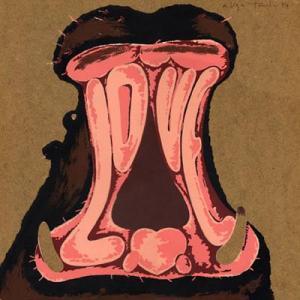 |
| Armando Testa, Ippopotamo Innamorato, 1982, Arcadja Auctions |
Armando Testa loved creating illustrations with animals and really experimented with fonts. The gaping maw of the hippopotamus is really showing us some love. But the abstract nature of the illustration first reminds us of how often we see hippopotami in this same posture. This poster definitely shows us the eclectic styling of Conceptual art, complete with a little heart as his tongue.
This chicken image is really fantastic in that you don't realize at first that he is made from the letters "p" and "n". The feet, lobes, waddle and comb are painted and the wings created with a lowercase 'p", the breast in the "n" and she is perfectly shaped into the chickens we all know. Testa experimented with this technique by changing the weight and sizes of each "p"; he clearly had this technique mastered and a sense of humor to boot. This illustration reminds me of the Calligrammes made popular from 1913 to 1916 by Guillaume Apollinaire, but instead, we have poultry in motion rather than a poem.
 |
| Armando Testa, the "P" Chicken, |
 |
| Milton Glaser for Eros Magazine, 1962 |
.
I had to find something from Milton Glaser because I really like his work. This illustration is so simple, but when you take a close look, it is quite detailed.
In this sketch he really demonstrates that "desire for originality; a thirst for the new; and a reverence for the precious, unique art object".1
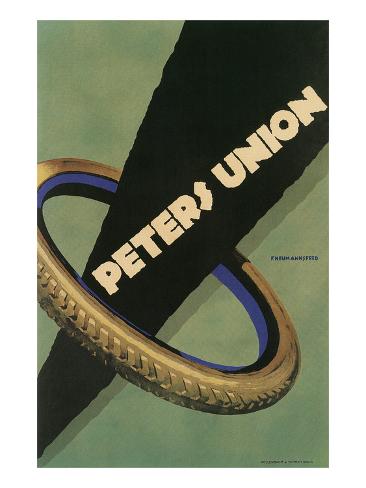
These illustrations demonstrate to me how an artist can take an animal and make it playful, serious and tough. I enjoy the artists that have this ability because it really is a clever talent. Especially when the animal is connected to a product like the Pirelli tire poster.
Citations:
- Philip B. Meggs, A.W. Purvis, Megg's History of Graphic Design, John Wiley & Sons, Inc., New Jersey, 2012
- Circopedia, The Polish "Cyrk" Posters, http://www.circopedia.org/The_Polish_%22Cyrk%22_Posters